
The discussions took place on the sidelines of the G20 Foreign Ministers' Meeting.

'We have to be equally vigilant in the central sector which is where Barahoti lies and also in the Joshimath area.'
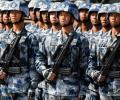
With the Indian Army having blocked the PLA several kilometres inside India, hundreds of soldiers from both sides remain in a tense face-off.
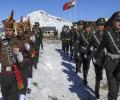
'They also agreed that for the overall development of bilateral relations it was essential to maintain enduring peace and tranquillity in the border areas,' the MEA said in a statement.
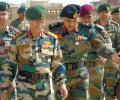
In his initial remarks, Army Chief General M M Naravane briefed the commanders about the overall situation following which detailed discussions on the matter took place, the sources said.
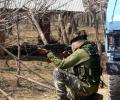
Two top Army commanders on Saturday said the fresh ceasefire between India and Pakistan will have no bearing on the counter-terrorism operations in Jammu and Kashmir and that the force will exercise 'maximum restraint' in the event of any violation by the neighbouring country.
India has told China not to "shift goalposts" and "confuse" managing the border affairs and restoring peace at the frontiers with the larger issue of the resolution of the boundary question, which is dealt with by different designated mechanisms.
The sources said there was clear sign of withdrawal of structures and troops from the patrolling point 14 in Galwan Valley and that they are likely to move back more than a kilometre in the area.
The two sides agreed that the next round of military dialogue should be held at an early date.

The stand by China spelt out by its foreign ministry insisting that it takes the 1959 line on perception of the LAC amid a nearly five-month-long border standoff in eastern Ladakh triggered a strong reaction from India.
"The meeting thus did not result in resolution of the remaining areas," the Army said in a statement.

'We would have faced many more Galwans had Indian troops not reacted and retaliated the way they did.'

Prime Minister Narendra Modi's bilateral meetings on the sidelines of the BRICS summit in Johannesburg are being finalised, Foreign Secretary Vinay Kwatra said on Monday but did not give a direct reply on the possibility of a meeting between Modi and Chinese President Xi Jinping.
The fresh round of Corps Commander talks are scheduled to start at 10:30 AM at Moldo border point on the Chinese side of the Line of Actual Control in eastern Ladakh, they added.
With regard to where relations between New Delhi and Beijing stand, the Union minister said that he does not have a definite answer to offer at "this moment".
Both the Indian and Chinese armies have brought in more troops in sensitive locations like Demchok, Daulat Beg Oldie and areas around Galwan river as well as Pangong Tso lake in Ladakh, the sources said. The area around Galwan has been a point of friction between the two sides for over six decades.
When asked for an update on Tuesday's military-level talks, Chinese foreign ministry spokesperson Hua Chunying told a media briefing in Beijing that both sides reached progress for promoting further disengagement of the border troops at the Western Sector.

The marathon fourth round of Lt Gen-level talks also focussed on steps for pulling back large number of troops and weapons from rear bases along the Line of Actual Control in eastern Ladakh.

India and China made progress in five-six friction points along the Line of Actual Control in eastern Ladakh through talks in the last three years and efforts are underway to resolve the remaining issues, External Affairs Minister S Jaishankar said on Monday.
It said India will continue to take 'robust and decisive' steps to ensure its national security.

'I want to assure this House that in these talks we have not conceded anything.' Full text of what Defence Minister Rajnath Singh told Parliament on the Chinese pullback in eastern Ladakh.
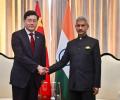
Qin's first in-person meeting with Jaishankar on Thursday came on the sidelines of the G20 foreign ministers conclave in New Delhi amid the over 34-month-long border row in eastern Ladakh.
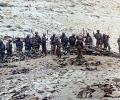
In the 15-year dataset, the researchers noted an average of 7.8 incursions per year even though the Indian government's estimates are much higher.
'Leaders of the two nations have reportedly agreed to set up a hotline between their respective military headquarters,' state-run Global Times daily reported on Wednesday.

The MEA spokesperson further said the actions and behaviour of the Chinese side since earlier this year along the LAC have been in "clear violation" of the bilateral agreements and protocols concluded between the two countries to ensure peace and tranquility on the border.
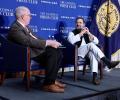
Asserting that Indian democracy is a "global public good", Congress leader Rahul Gandhi has said that its "collapse" will have an impact on the world and is not in America's national interest.

External Affairs Ministry Spokesperson Anurag Srivastava said the diplomatic and military talks have helped both sides to enhance understanding of each other's positions on the issue.

The Army has also further bolstered overall surveillance mechanisms in all areas along the Line of Actual Control (LAC) in eastern Ladakh after foiling China's fresh attempt to occupy an area on the southern bank of Pangong lake, they said.

In the first highest level face-to-face contact between the two sides after border tension erupted in eastern Ladakh in early May, Singh and Wei met for two hours and 20 minutes in Moscow on Friday evening on the sidelines of a meeting of the defence ministers of the Shanghai Cooperation Organisation.

India and China on Friday held 'in-depth' discussions on addressing the remaining issues along the Line of Actual Control (LAC) in eastern Ladakh, holding that disengagement in the North and South banks of Pangong lake provided a good basis to work towards their early resolution.
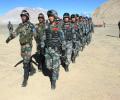
The talks between the two armies are going to be held this week at multiple locations including Patroling point 14 (Galwan area), Patrolling point 15, and Hot Springs area, top government sources said.
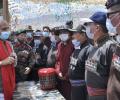
The dedication of Indian soldiers and veterans towards the country is an 'exemplary example', Defence Minister Rajnath Singh said on Sunday soon after arriving in Ladakh on a three-day visit aimed at taking stock of India's military preparedness in the region in the face of a prolonged border row with China.

China has chosen to keep New Delhi guessing, while retaining for itself the option of constantly changing facts on the ground and shifting the LAC westwards -- the strategy called 'salami slicing', notes Ajai Shukla.
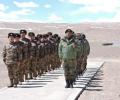
The sources said the ongoing engagement and dialogue at military and diplomatic levels have resulted in complete disengagement of troops at patrolling point 14, 15 and 17 A in eastern Ladakh.
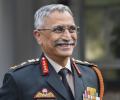
Gen Naravane also said the Army will enhance combat capabilities along the border with China so that it is fully prepared to deal with any security challenge.
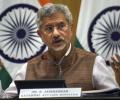
"What just happened is that we have agreed on the need to disengage because the troops on both sides are deployed very close to each other. "So there is a disengagement and de-escalation process which has been agreed upon," he said during an video interactive session at the India Global Week.

The Border Defence Cooperation Agreement inked between India and China on Wednesday facilitates establishment of a hotline between the military headquarters of the two countries, besides border personnel meeting sites in all sectors receiving broad directive not to tail each others' patrols along the disputed borders.
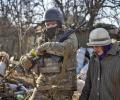
India has repeatedly called on Russia and Ukraine to return to the path of diplomacy and dialogue and end their ongoing conflict.

The formal process of disengagement of troops began on July 6, a day after a nearly two-hour telephonic conversation between National Security Advisor Ajit Doval and Chinese Foreign Minister Wang Yi on ways to bring down tensions in the area.

The army chief said that India needs to broaden its understanding of national security and must examine non-traditional threats like pandemics "de-novo" as they have the potential to inflict severe damage on the country. "We need to act and prepare ourselves accordingly."
